
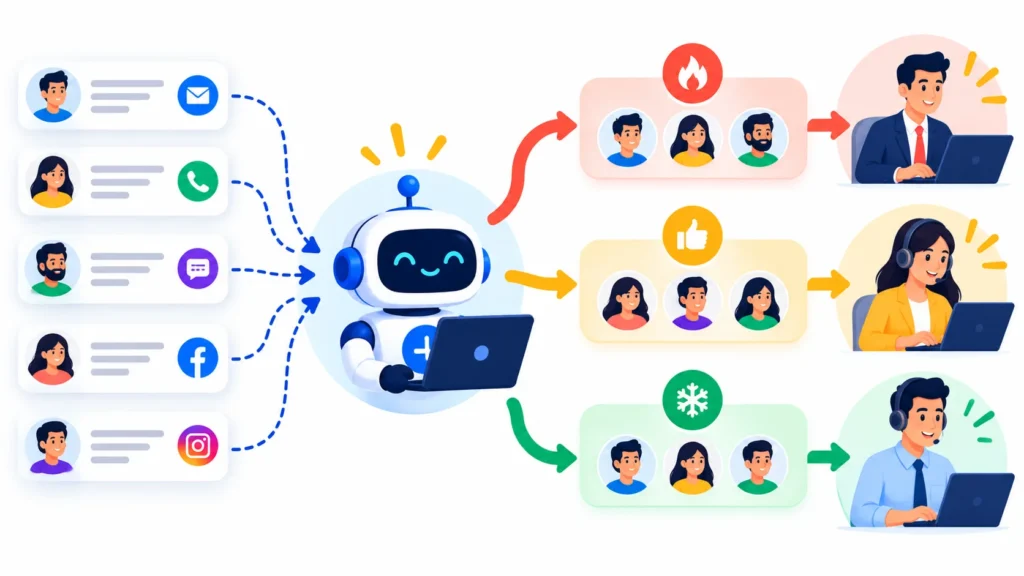
Not every enquiry is worth the same, and your best leads should never wait behind poor ones. AI lead qualification asks a few questions, scores the answers and sends each lead to the right person or follow-up. It works best when the rules are simple and your team stays in charge of the final call.
Quick Answer: What Is AI Lead Qualification?
It is a process where a form, chatbot or CRM collects key details from a new enquiry, scores the fit and urgency, and routes it automatically. AI helps by reading free-text answers and spotting intent. You decide the rules.
Define a Qualified Lead First
Before using any tool, write down what “qualified” means for you. Examples: located in your service area, budget in range, needs the service within 30 days, decision maker involved. If your team cannot agree on the definition, AI will only automate the confusion.
Qualifying Questions Worth Automating
- What service do you need?
- Where are you located?
- When do you want to start?
- What is your approximate budget range? (optional)
- How should we contact you, and when?
Keep forms short. Each extra field lowers completion, so only ask what changes your next step.
Simple Scoring Rules That Work
- Fit (0 to 3): service area, service match, budget range.
- Urgency (0 to 3): this week, this month, just researching.
- Intent (0 to 3): asked for a quote or call, downloaded a guide, only browsed.
Add the points. High scores go straight to a person with an alert. Medium scores get an automated reply plus a booking link. Low scores enter a slower nurture sequence. Review the thresholds monthly against the leads that became customers.
Routing and Alerts
- Send hot leads to the first available person with a phone or WhatsApp alert.
- Route by location, service or language where you have a larger team.
- Create a CRM task with a deadline so no lead sits unseen. See how to respond to leads in under 5 minutes.
Where AI Adds Value
- Reading free-text answers such as “need it fixed before the weekend”.
- Summarizing the enquiry for the person who calls back.
- Flagging spam or duplicate submissions.
Limits and Bias
- Scores can reflect your past data, including past mistakes.
- Do not reject people automatically based on names, locations that proxy protected traits, or other sensitive attributes.
- Keep a person in the loop for decisions that affect access to services.
- Tell people how you use their details and honor opt-outs.
Tools That Can Do This
Most CRMs include lead scoring or routing rules, and automation platforms such as Zapier, Make and n8n can connect forms to a CRM. Compare current features on each vendor’s page and test with real leads before you commit. See our guide on choosing a CRM.
Common Mistakes to Avoid
- Over-complicated scoring nobody understands.
- No owner for hot leads.
- Never checking if high scores actually became customers.
- Hiding the phone number behind a long form.
When to Get Professional Help
If your ads, website and CRM need to share one scoring system, GlobDigi can build it. Start with our services page.
Frequently Asked Questions
Do I need AI for lead scoring?
No. Simple rules in a CRM work for many businesses. AI helps when answers are free text or volume is high.
How many questions should a form have?
As few as possible, usually four to six.
How do I know the scoring works?
Compare scores with closed deals every month and adjust.
Conclusion
Define a qualified lead, score with simple rules, route fast and let people make the final decisions.
Need lead scoring built into your ads and CRM? Talk to GlobDigi.
Sources: General guidance based on standard CRM and automation practice; check vendor pages for current features. This is not legal advice.
Related Reading

Disclaimer: This article is for general information only. Prices, features, policies, laws and results can change or may not apply to your situation, and we do not guarantee accuracy, outcomes or future performance. Please verify important details, including pricing and commitments, with the official source or website, or a qualified professional, before acting on them.