

There is no fixed price for Google Ads. You set a budget, and in most campaigns you pay when someone clicks your ad. What each click costs depends on your industry, location, competition and how well your ads and pages are built. This guide explains how the costs work and shows one published 2026 benchmark by industry, so you can plan a realistic budget.
Quick Answer
- Google Ads has no minimum spend. You choose a daily or monthly budget.
- In search campaigns you usually pay per click (CPC). Average CPC varies widely by industry, from a couple of dollars to nearly ten dollars in one 2026 benchmark.
- Your real cost that matters is cost per lead or per sale, not cost per click.
How Google Ads Pricing Works
Google runs an auction every time someone searches. Your ad competes with others based on your bid and the quality of your ad and landing page. Higher quality can earn a better position at a lower price per click.
- Cost per click (CPC): you pay when someone clicks. Most search campaigns work this way.
- Cost per thousand views (CPM): common for display and video, where you pay for impressions.
- Cost per acquisition (CPA): an automated bidding goal where you aim for a target cost per conversion. You still pay per click, but the system bids to hit your target.
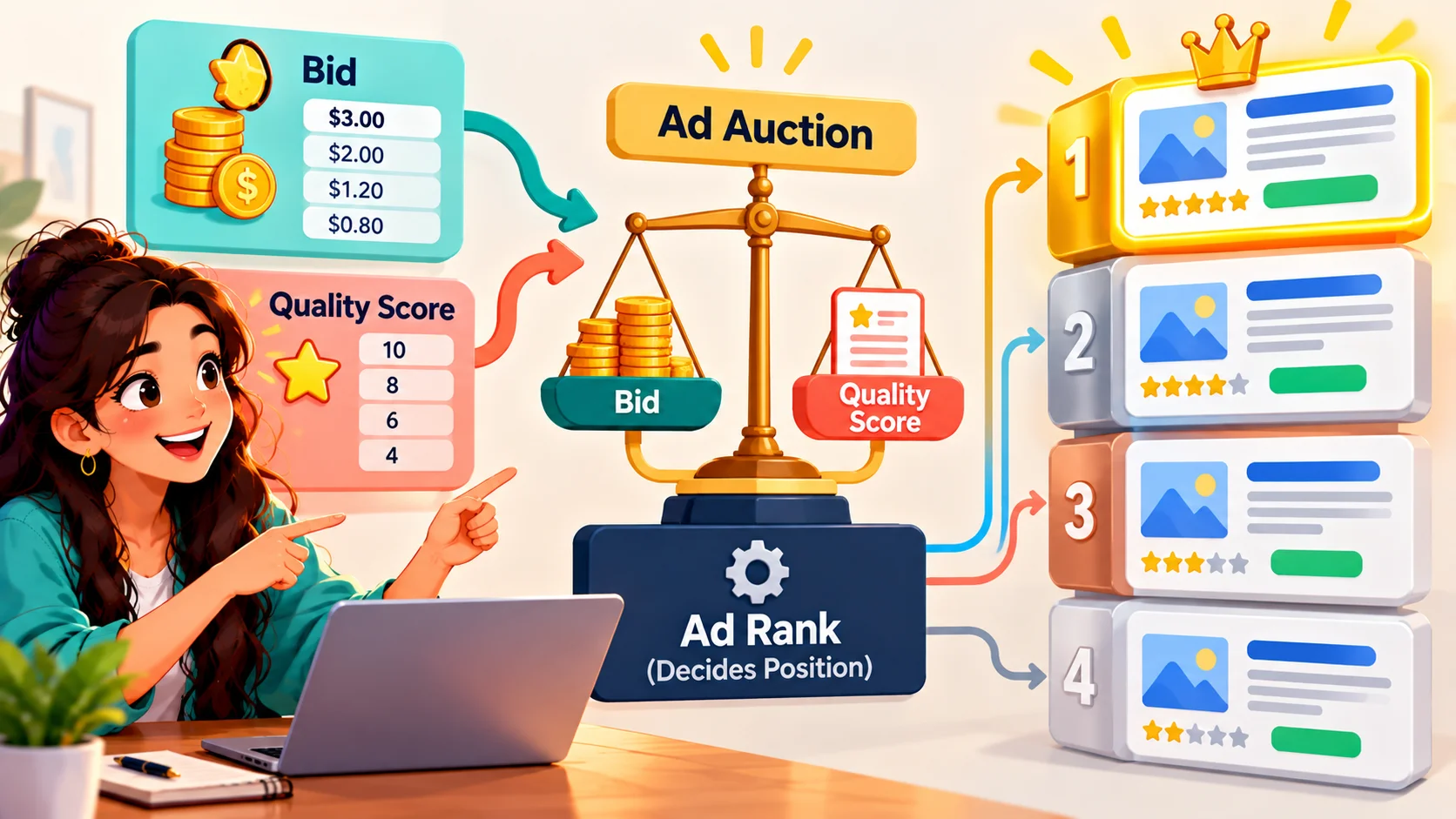
What Makes Google Ads Cost More or Less
- Industry competition: legal, home services and dental advertisers often pay more per click.
- Location: big cities and high-income areas can cost more.
- Keyword intent: “emergency plumber near me” costs more than “how does a tap work”.
- Quality: relevant ads and fast, useful landing pages usually lower costs over time.
- Bidding strategy and budget: automated bidding can raise or lower costs depending on data and goals.
- Season and demand: peak periods often push costs up.
Average CPC by Industry: One 2026 Benchmark
The table below shows selected US search CPC figures from a 2026 benchmark study by Focus Digital, which reports an overall average of about $5.42. Treat these as a guide rather than a promise. Different sources report different numbers, and your own account will vary.
| Industry | Average CPC (2026 benchmark) |
|---|---|
| Attorneys and legal services | $9.87 |
| Home and home improvement | $8.33 |
| Dentists and dental services | $8.00 |
| Health and fitness | $6.17 |
| Business services | $5.87 |
| Education and instruction | $4.81 |
| Beauty and personal care | $4.62 |
| Real estate | $3.22 |
| Restaurants and food | $2.05 |
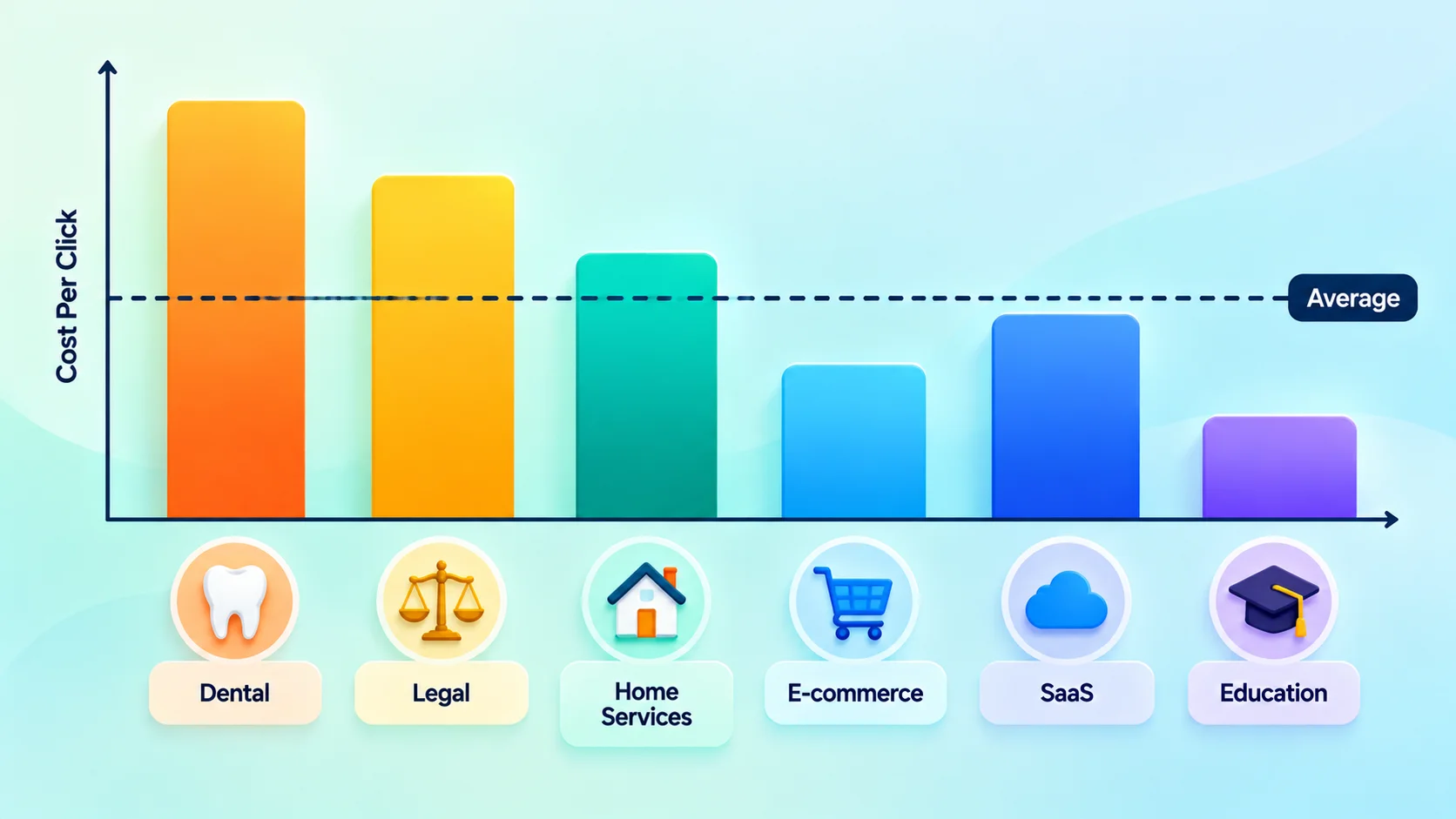
Caveats: the study mixes methods (it describes medians in one place and a total-spend-over-clicks average in another), covers US campaigns with conversion tracking, and is a single vendor’s analysis. Use it to compare industries, not to predict your invoice.
From CPC to a Real Monthly Budget
Work backwards from the leads you want:
- Estimate your conversion rate (clicks that become enquiries). Use your own data if you have it.
- Calculate cost per lead: CPC divided by conversion rate.
- Multiply by the leads you need each month.
Illustrative example: if clicks cost $6 and 10% of clicks become leads, each lead costs about $60. Ten leads a month would need roughly $600 in ad spend, before management fees and tools. If 1 in 4 leads becomes a customer, each customer costs about $240 in ad spend, so check that against what a customer is worth.
Do Not Forget Management Fees
Ad spend goes to Google. If an agency or freelancer manages your account, there is usually a separate fee, charged as a flat monthly amount, a percentage of spend or a mix. Our guide to small business marketing budgets explains how to split spend.
How to Lower Your Costs
- Track calls and forms so Google can optimise for real leads. See call tracking for small business.
- Block irrelevant searches with negative keywords.
- Send each ad to a matching landing page.
- Write clear, specific ads. See how to write ad copy.
- Choose the right bidding strategy for your data. See bidding strategies for beginners.
Common Mistakes
- Judging success by CPC instead of cost per lead.
- Starting with a budget too small to collect useful data.
- Copying someone else’s benchmark as your target.
- Not tracking which clicks become customers.
When to Get Professional Help
If your cost per lead is high or you are unsure what budget makes sense, GlobDigi can review your account and plan. See our Google Ads services.
Frequently Asked Questions
What is the minimum budget for Google Ads?
There is no minimum, but very small budgets may not gather enough data to learn quickly.
Why is my CPC higher than the average?
Your location, keywords, quality and competition all affect it. Averages are only a starting point.
Do I pay if nobody clicks?
In pay-per-click campaigns, no. You pay for clicks, not for impressions.
Is a high CPC always bad?
No. A higher CPC can still be profitable if those clicks become valuable customers.
Conclusion
Plan from cost per lead, not cost per click. Use benchmarks to compare, track real results and adjust.
Want a realistic budget? Request a free Google Ads audit from GlobDigi.

Source: Focus Digital, Average Google Ads Cost per Click by Industry (2026). Figures checked October 2026 and may change.