

If you’re a coach, course creator, tutor or run an education business, you’ve probably heard that Facebook and Instagram are “full of leads”.
They are. But here’s what nobody tells you: getting leads is the easy part. Getting leads that answer the phone, show up to calls and actually sign up is where most people struggle.
This guide shows you how to use Meta Lead Ads to get better-quality leads, with no tech skills needed.
What Are Meta Lead Ads?
Lead Ads are Facebook and Instagram ads with a built-in form. When someone taps your ad, a form pops up, often already filled in with their name, email and phone from their profile. They tap “Submit” without ever leaving the app.
The upside: it’s super easy, so you get more leads, often at a lower cost.
The downside: it’s so easy that some people submit without really thinking. That’s why lead quality needs attention.

Step 1: Offer Something People Actually Want
“Contact us” is not an offer. Give people a clear reason to hand over their details:
- Coaches: “Free 20-minute strategy call”, “Free goal-setting workbook”
- Course creators: “Free mini-course”, “Watch the free training”, “Download the checklist”
- Tutoring / test prep: “Free practice test + score review”
- Schools and institutes: “Download the program guide”, “Book a campus tour”, “Free trial class”
The more specific and useful the offer, the better the leads.
Step 2: Add a Little Friction (Yes, Really)
This sounds backwards, but making the form slightly harder often improves quality a lot.
- Add 1–3 simple questions. For example, “What’s your biggest challenge right now?” or “When are you looking to start?” People who answer honestly are usually more serious.
- Use multiple-choice answers. They’re easy to answer and easy for you to sort.
- Use the “Higher intent” form type. Meta adds a review screen before people submit. You may get fewer leads, but usually better ones.
Example qualifying questions
| Business | Question |
|---|---|
| Business coach | “What’s your current monthly revenue?” (ranges) |
| Fitness/health coach | “How soon do you want to get started?” |
| Test prep | “When is your exam date?” |
| Online course | “What’s your experience level?” |
| School/institute | “Which program are you interested in?” |
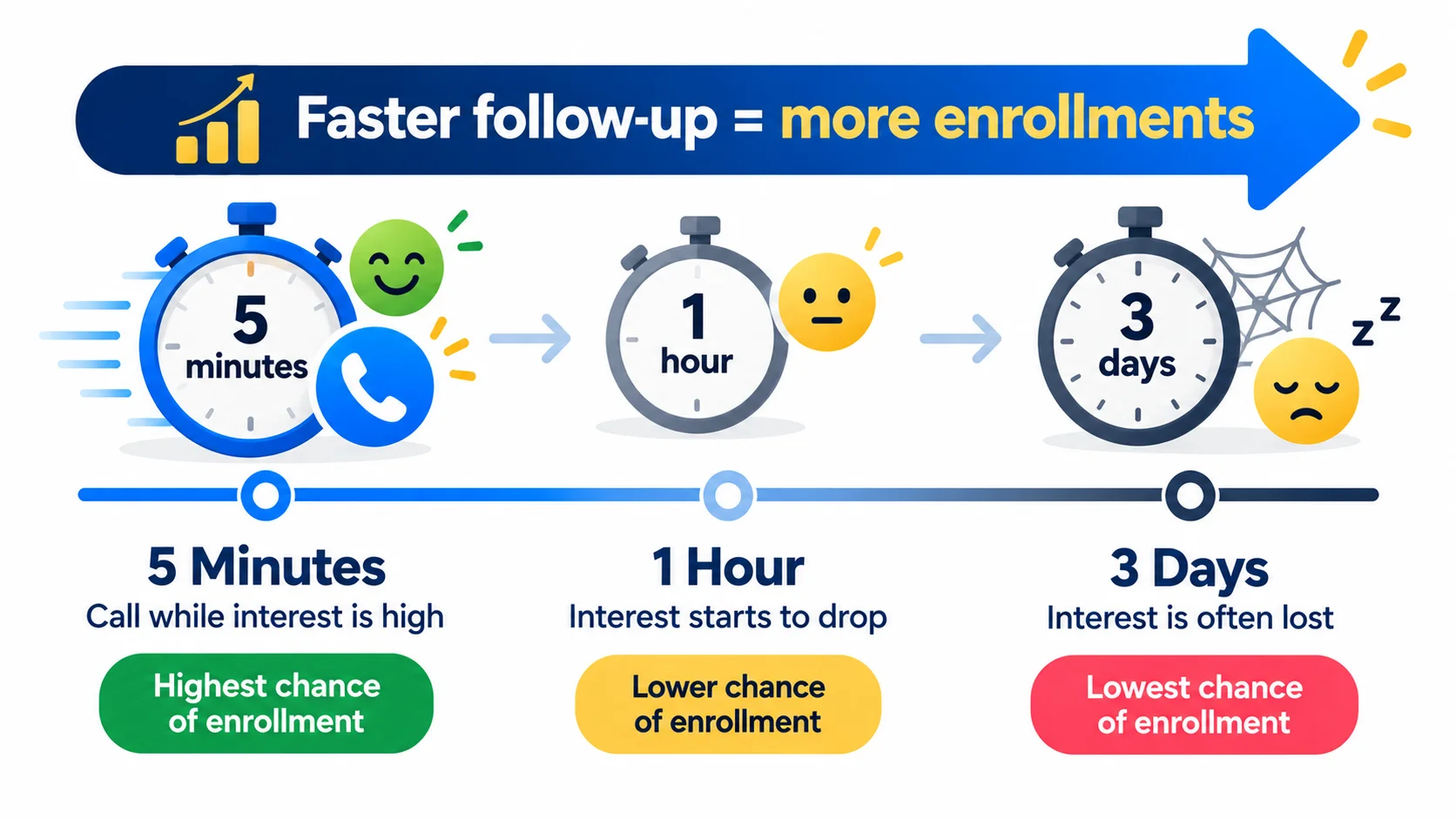
Step 3: Follow Up Fast
This is where most coaching and education businesses lose leads.
Someone fills in your form while scrolling on the couch. If you call them three days later, they’ve forgotten who you are. If you reach out within minutes, they’re still thinking about it.
- Connect your Lead Ads to your CRM or email tool so leads arrive instantly, not in a spreadsheet you check once a week.
- Send an automatic text or email right away: “Thanks, [Name]! Here’s your free guide. Want to book a quick call? [link]”
- Call during business hours as soon as possible.
- Use a booking link on the thank-you screen so people can schedule a call immediately.
Step 4: Tell Meta Which Leads Were Good
By default, Meta treats every form submission as a success. But you know that some leads book calls and enroll while others never answer.
If you connect your CRM to Meta and mark which leads became real opportunities or customers, Meta can use this to find more people like your best leads, not just anyone who fills in forms. Meta calls this optimizing for “conversion leads”. It usually needs a bit of setup, but it can make a big difference over time. Features change, so verify with the official source or website; info may be inaccurate or outdated.
Step 5: Write Ads That Sound Like You
People buy coaching and education from people they trust. The best ads usually:
- Feature you (or your teachers) talking directly to camera
- Share a real story or a quick, useful tip
- Show real student or client results, honestly
- End with one clear next step
Important: Be Careful with Claims
Coaching and education ads get extra attention from Meta, and in the US from regulators like the FTC.
- ❌ Don’t promise specific income (“Make $10K a month in 30 days!”)
- ❌ Don’t guarantee exam scores or job placement unless you can back it up
- ❌ Avoid “get rich quick” language
- ✅ Share real, typical results with honest context
- ✅ Focus on skills, support and the learning experience
Misleading claims can get your ads rejected, your account restricted, and damage your reputation.
Common Mistakes to Avoid
- Using a vague offer like “Learn more” or “Contact us”
- No qualifying questions, so everyone gets in
- Letting leads sit for days before follow-up
- Judging ads by cost per lead only, not by calls booked or enrollments
- Running the same ad for months without refreshing it
Quick Answers to Common Questions
Are Lead Ads better than sending people to my website?
Lead Ads usually get more leads at a lower cost. Website forms often bring fewer but more serious leads. Many coaches test both and compare how many actually enroll.
How much should I spend on Meta Lead Ads?
Many small coaching and education businesses start with around $1,000–$1,500 a month, though this varies a lot and is only an example. Read our guide on how to start Meta Ads with $1,500 a month for a simple plan, and verify current costs with Meta’s official site.
Why do my leads never answer the phone?
Usually it’s slow follow-up, no qualifying questions, or an offer that attracts freebie seekers. Fix those three things first. You might also find our guide on why Meta Ads get clicks but no leads helpful.
The Bottom Line
Meta Lead Ads can fill your calendar with calls and your programs with students, as long as you focus on quality, not just quantity. Offer something genuinely useful, ask a couple of smart questions, follow up fast, and tell Meta which leads were good.
See how we help coaches and educators on our education and coaching, coaching and training, online courses and EdTech and schools and institutes pages.
👉 Get a free Meta Ads audit. We’ll look at your ads, forms and follow-up, and show you how to get more leads who actually enroll.
Disclaimer: This article is for general information only. Prices, features, policies, laws and results can change or may not apply to your situation, and we do not guarantee accuracy, outcomes or future performance. Please verify important details, including pricing and commitments, with the official source or website, or a qualified professional, before acting on them.