
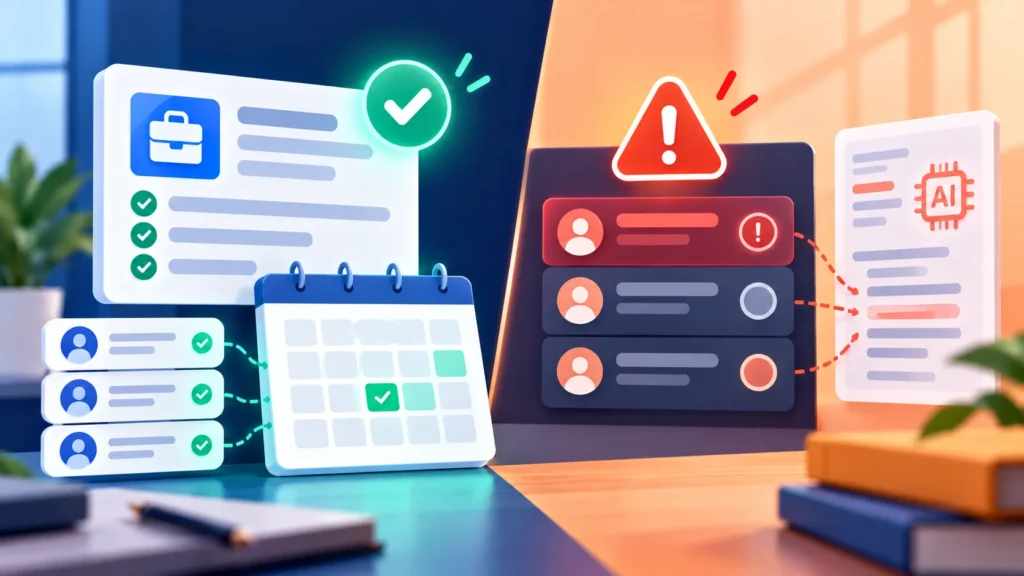
Hiring takes a lot of time, so it is natural to ask AI for help. Some uses are safe and useful. Others can lead to unfair decisions and even legal trouble. This guide separates the two in simple terms.
Quick Answer: Is It Okay to Use AI for Hiring?
Yes for low-risk tasks like drafting job posts and scheduling interviews. Be much more careful when AI is used to score, rank or reject candidates. In some places, that kind of tool has legal rules. A real person should make the final decision.
Low-Risk Uses
- Drafting a clear job description, which you then edit.
- Writing a friendly reply to candidates.
- Scheduling interviews and sending reminders.
- Making a list of good interview questions for the role.
- Summarizing your own interview notes.
Even here, read everything before it goes out. A wrong requirement or a careless word in a job post can put off good people.
Higher-Risk Uses: Screening and Ranking
- Auto-rejecting CVs.
- Scoring or ranking candidates.
- Analyzing video interviews or voice.
- Predicting who will “fit” or stay long.
These can quietly favor or block certain groups, even when nobody meant it to. The tool may have learned from past hiring that was unfair.
Bias and Fairness
In May 2023, the US EEOC said that employers should make sure AI tools used in hiring line up with civil rights law, and that employers can still be responsible for results from a vendor’s tool. So asking “the vendor said it is fair” is not enough.
- Ask the vendor how the tool was tested for bias.
- Check results by group where the law allows it.
- Do not use AI to guess age, health, religion or other protected traits.
Local Rules to Check
Rules differ by place. One example: New York City’s Local Law 144 covers automated employment decision tools. It requires a bias audit within the past year, a public summary of the results, and notices to candidates and employees (at least 10 business days before use). It has been enforced since 5 July 2023. Other places have their own rules, and privacy law like GDPR can also apply to candidate data. Laws change, so verify the current rules with the official government source. If you hire in more than one place, check each one or ask a lawyer.
Keep a Person in the Decision
- Let AI help organize information, not decide.
- Have a person read the applications that AI rejects, at least as a sample.
- Use the same questions for every candidate.
- Write down why each decision was made.
Be Open With Candidates
Tell candidates if you use AI in the process, what it does and how to ask for a person to review. Offer another way to apply if someone needs it, for example due to a disability.
Common Mistakes to Avoid
- Letting AI auto-reject without human review.
- Buying a screening tool without asking about bias testing.
- Pasting full candidate details into a free chatbot.
- Not telling candidates that AI is used.
When to Get Professional Help
For hiring law, speak with an employment lawyer. For writing your own rules on AI use, start with our guide to an AI policy for small business.
Frequently Asked Questions
Can AI write job descriptions?
Yes. Edit the draft so it is accurate and uses fair, plain language.
Can I use AI to filter CVs?
You can in many places, but it is higher risk. Check local rules and keep a person in charge.
Who is responsible if the AI is biased?
You can still be responsible as the employer, even if the tool came from a vendor.
Conclusion
Use AI for the paperwork around hiring, but be careful with anything that judges people. Check local rules, be open with candidates and let people make the final call.
Need help with the marketing side of your business? Contact GlobDigi.
Sources: EEOC press release, 18 May 2023; NYC Department of Consumer and Worker Protection: automated employment decision tools. Checked October 2026; rules change, so confirm for your location. This is general information, not legal advice.
Related Reading

Disclaimer: This article is for general information only. Prices, features, policies, laws and results can change or may not apply to your situation, and we do not guarantee accuracy, outcomes or future performance. Please verify important details, including pricing and commitments, with the official source or website, or a qualified professional, before acting on them.